
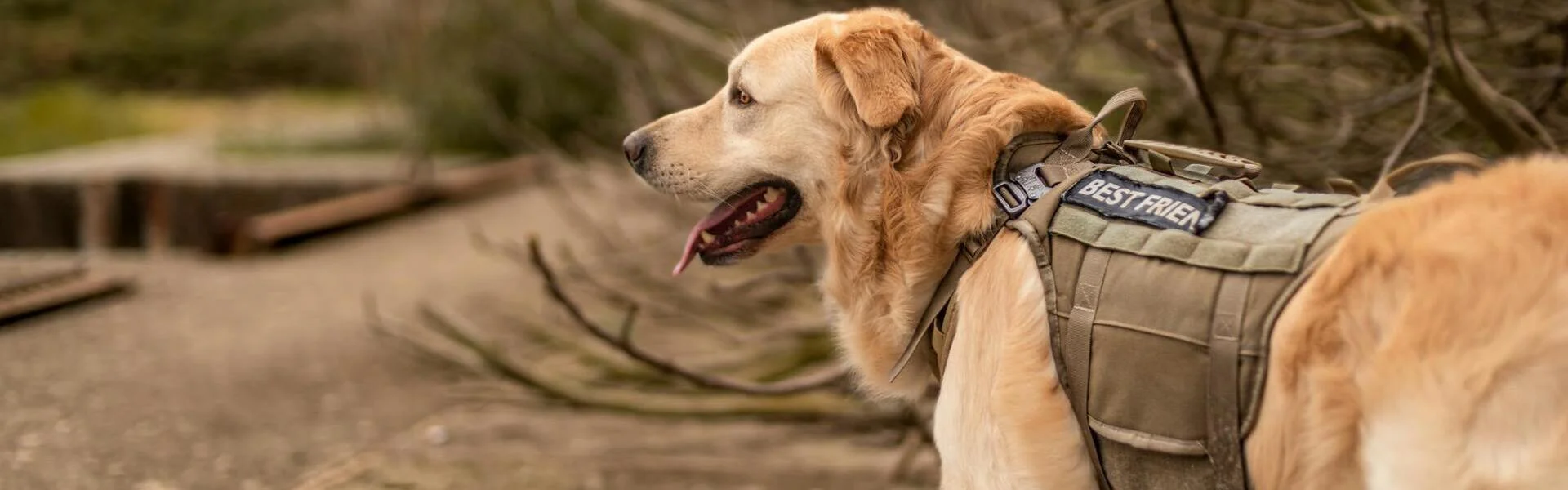
Service Dog Training in Amarillo, TX
Train your dog to perform disability-specific tasks with professional ADA-compliant service dog training in Amarillo. Psychiatric service dogs, mobility assistance, PTSD support, seizure alert, diabetic alert, and autism support dog training. Programs starting at $625 with lifetime support. Backed by 261+ five-star reviews.
Professional Service Dog Training for Amarillo and the Texas Panhandle
A service dog is not just a pet that accompanies you in public. Under the Americans with Disabilities Act (ADA), a service dog is individually trained to perform specific tasks directly related to a person's disability. That distinction is critical — and it is what separates a trained service dog from an emotional support animal or a therapy dog.
At Off Leash K9 Training Amarillo, we provide the professional, task-specific training your dog needs to become a reliable, ADA-compliant service dog.
Whether you need a psychiatric service dog for PTSD or anxiety, a mobility assistance dog, a seizure or diabetic alert dog, or an autism support dog, our training programs build the obedience foundation and task-specific skills required for your dog to serve you safely and reliably in any public environment.
Owner and head trainer Tiffany Singleton and her team at Off Leash K9 Training Amarillo have trained hundreds of dogs to advanced levels of obedience and task reliability. With 261+ five-star Google reviews and a reputation built on real results, we are the most trusted dog training team in the Texas Panhandle for service dog task training.
We serve families throughout Amarillo, Canyon, Pampa, Plainview, Bushland, and every community in the Texas Panhandle. If you have a dog that you want to train as your service dog, or if you need help selecting the right candidate, we are here to help.
What Is a Service Dog Under the ADA?
The Americans with Disabilities Act defines a service dog as a dog that is individually trained to do work or perform tasks for the benefit of a person with a disability. The tasks the dog performs must be directly related to the handler's disability.
This is not a matter of registration, certification, or a vest. Under federal law, there is no official service dog registry in the United States. Any website claiming to "certify" or "register" your service dog for a fee is a scam. What makes a dog a service dog is task training — the specific, trained behaviors the dog performs to mitigate the handler's disability.
- No registration required. The ADA does not require service dogs to be registered, certified, or carry identification.
- Any breed qualifies. There are no breed restrictions for service dogs under the ADA. Any breed can be a service dog.
- Public access rights. Service dogs are allowed in all public places where other people are allowed — restaurants, stores, hospitals, airplanes, hotels.
- Two questions businesses can ask: (1) Is this a service animal required because of a disability? (2) What task has the dog been trained to perform?
- Owner-trained dogs qualify. You do not need a professional organization to train your service dog. Owner-trained service dogs have the same legal rights.
Our role at Off Leash K9 Training Amarillo is to provide the professional task training and advanced obedience your dog needs to function reliably as a service dog. We train the dog and teach you to handle the dog so that together you can navigate public spaces safely and confidently.
Service Dog vs. Therapy Dog vs. Emotional Support Animal
These three designations are frequently confused, but they have very different legal rights, training requirements, and purposes. Understanding the differences is essential before starting any training program:
| Factor | Service Dog | Therapy Dog | Emotional Support Animal |
|---|---|---|---|
| Legal Protection | ADA (federal law) | None (facility permission) | Fair Housing Act only |
| Public Access Rights | All public places | Only invited facilities | Housing only |
| Task Training Required | Yes — disability-specific tasks | Obedience + temperament testing | No training required |
| Who They Help | Their handler (one person) | Others (patients, students, etc.) | Their owner (one person) |
| Registration Required | No (none exists legally) | Through certifying organization | No (letter from provider) |
| Airline Access | Yes (DOT protected) | No | No (since 2021) |
| Restaurant / Store Access | Yes (legally required) | No | No |
Looking for therapy dog training instead? We offer a separate therapy dog training program for dogs that will visit hospitals, schools, nursing homes, and other facilities to provide comfort to others. Therapy dog training focuses on temperament, public manners, and certification through organizations like Alliance of Therapy Dogs — it is a different program with different goals than service dog task training.
Types of Service Dog Training We Offer in Amarillo
We provide professional task training for multiple types of service dogs. Every program is customized based on your specific disability, your dog's temperament and abilities, and the tasks you need your dog to perform reliably:
Psychiatric Service Dog Training
For handlers with PTSD, anxiety disorders, depression, bipolar disorder, and other psychiatric conditions. Tasks include deep pressure therapy during panic attacks, nightmare interruption, creating physical space in crowds, medication reminders, dissociation interruption, and guiding handlers to exits during episodes. Psychiatric service dogs are the most requested type in the Texas Panhandle, especially among veterans.
PTSD Service Dog Training
Specifically designed for veterans, first responders, and trauma survivors. Tasks include room clearing and perimeter checks, watching the handler's back in public (covering), blocking people from approaching, waking from nightmares, detecting anxiety onset and performing grounding behaviors, and leading handlers away from triggering environments. We proudly serve veterans from the Amarillo VA and throughout the Panhandle.
Mobility Assistance Dog Training
For handlers with physical disabilities, balance disorders, arthritis, multiple sclerosis, muscular dystrophy, or injuries. Tasks include bracing for balance, retrieving dropped items, opening and closing doors, pulling wheelchairs, carrying items, pressing buttons and switches, and providing stability during transfers. Dogs must be large enough and physically suited for mobility work.
Seizure Alert and Response Dog Training
For handlers with epilepsy and seizure disorders. Response tasks include staying with the handler during a seizure, clearing space around the handler, activating a medical alert device, retrieving medication, and finding help. Some dogs develop the ability to alert before a seizure occurs, though this behavior is often innate rather than trainable — we can reinforce and shape alert behaviors when present.
Diabetic Alert Dog Training
For handlers with Type 1 or Type 2 diabetes who experience dangerous blood sugar fluctuations. Dogs are trained to detect changes in the handler's scent associated with hypoglycemia or hyperglycemia and alert the handler to check their blood sugar, retrieve glucose supplies, or alert another person if the handler is incapacitated.
Autism Support Dog Training
For children and adults on the autism spectrum. Tasks include providing deep pressure therapy during meltdowns, tethering to prevent elopement (bolting) in children, interrupting repetitive behaviors, providing sensory input during overstimulation, and creating a physical buffer in overwhelming social environments. Autism support dogs dramatically improve safety and quality of life for families.
Do not see your specific need listed? Call us at (806) 680-6845 — we can discuss your disability-related needs and determine if service dog task training is appropriate for your situation.
Service Dog Training Programs and Pricing in Amarillo
Service dog training is a multi-phase process that starts with advanced obedience and progresses into disability-specific task training. We offer flexible program options based on where your dog currently is in their training and what level of service you need:
| Program | Format | Price | Best For |
|---|---|---|---|
| 2-Week Board & Train + Task Training | 2 Weeks Intensive | $2,000 | Accelerated obedience + introduction to disability-specific tasks |
| 2-Week Advanced Service Dog Program | 2 Weeks Intensive | $2,800 | Advanced obedience, public access training, and task refinement |
| 4-Week Elite Service Dog Program | 4 Weeks Intensive | $5,400 | Complete service dog transformation: advanced obedience, full task training, public access proofing |
| Task Training Add-On | 4 Private Lessons | $625 | Dogs with existing obedience that need specific task training only |
Nationally, a fully trained service dog from a dedicated organization costs $15,000 to $50,000, with waitlists of 1-3 years. Training your own dog with professional guidance through Off Leash K9 Training Amarillo costs a fraction of that — $625 to $5,400 depending on your dog's needs and your goals. You keep your own dog, avoid multi-year waitlists, and get the same task-trained results.
0% APR financing available through Affirm. Split your investment into affordable monthly payments with zero interest. We believe cost should never prevent someone with a disability from accessing the service dog training they need.
How Service Dog Training Works at Off Leash K9 Amarillo
Service dog training is more complex than standard obedience training. Our proven process ensures your dog develops the reliability, temperament, and task proficiency required for service dog work:
Free Assessment
We evaluate your dog's temperament, health, age, and suitability for service work. Not every dog is a good candidate — we will be honest about whether your dog can succeed. We also discuss your disability-related needs and which tasks would help.
Obedience Foundation
Every service dog needs bombproof obedience first. We train reliable sit, down, stay, heel, come, and place commands in all environments — around food, crowds, other dogs, and distractions. This is non-negotiable.
Task-Specific Training
We teach your dog the specific tasks related to your disability. Deep pressure therapy, alerting behaviors, item retrieval, bracing, grounding, nightmare interruption — whatever tasks you need, trained to reliability.
Public Access Training
Your dog learns to behave appropriately in all public environments — restaurants, grocery stores, medical offices, airports. Calm, focused, non-reactive behavior in any setting is mandatory for service dogs.
Handler Training and Support
We teach YOU how to work with your service dog as a team. Proper handling, task cueing, public access etiquette, and how to respond when businesses question your rights. Plus lifetime phone and email support.
What Makes a Good Service Dog Candidate?
Not every dog is suited for service work. During your free assessment, we evaluate your dog against the criteria that predict success in service dog training:
Temperament
The single most important factor. Service dogs must be calm, confident, and non-reactive. Dogs that are fearful, aggressive, hyperactive, or easily overstimulated are generally not good candidates. The dog should want to work with people and remain composed in novel environments.
Age and Health
Ideal candidates are between 6 months and 3 years old, though older dogs with stable temperaments can succeed. The dog must be in good health with no chronic pain or conditions that would limit working ability. For mobility work, hips and joints must be sound.
Size and Physical Ability
Size requirements depend on the tasks. Mobility and bracing dogs need to be large breeds (50+ pounds). Psychiatric service dogs, diabetic alert dogs, and seizure alert dogs can be any size. The dog's physical capabilities must match the tasks they will perform.
Drive and Focus
Service dogs need enough drive to work consistently but not so much drive that they become difficult to manage in public. The best candidates are attentive to their handler, eager to perform tasks, and can sustain focus for extended periods without becoming restless.
Social Neutrality
A good service dog candidate is neutral toward other dogs and strangers — not aggressive, not fearful, and not overly friendly. Dogs that desperately want to greet everyone or play with every dog they see will struggle in service work because they cannot focus on their handler.
Recovery From Stress
Service dogs encounter stressful situations — loud noises, crowded spaces, confrontational people, medical environments. Good candidates recover quickly from startling events rather than shutting down or becoming reactive. This resilience is essential for reliable public access work.
Honest assessment is part of our service. If your dog is not a good candidate for service work, we will tell you directly and discuss alternatives — including helping you find and evaluate a better candidate. We would rather save you months of training on the wrong dog than take your money knowing the outcome will disappoint.
Service Dog Laws in Texas: What You Need to Know
Texas law provides additional protections for service dog handlers beyond federal ADA requirements. As a service dog handler in Texas, you should understand these key legal facts:
Texas Human Resources Code Chapter 121
Texas state law specifically protects the right of persons with disabilities to be accompanied by their service animals in all public places, public accommodations, and on public transportation. Texas law also covers service dogs in training when accompanied by a qualified trainer.
Criminal Penalties for Interference
In Texas, it is a misdemeanor to interfere with a service dog performing its duties, deny access to a person with a service dog, or attack or injure a service dog. Penalties include fines and potential jail time. This gives Texas handlers stronger protections than the ADA alone.
Housing Rights
Under both the Fair Housing Act and Texas law, landlords must allow service dogs in housing with no pet deposit and no breed restrictions, even in properties with "no pets" policies. This applies to apartments, condos, and rental homes throughout Amarillo and the Panhandle.
No Registration or Certification Required
Neither federal nor Texas law requires service dogs to be registered, certified, or wear identifying vests or patches. Businesses cannot require documentation. The only legitimate questions are: (1) Is this a service animal required because of a disability? (2) What task has the dog been trained to perform?
During your handler training, we cover public access etiquette, how to respond when businesses challenge your access rights, and how to handle confrontational situations calmly and legally. Knowledge of your rights is as important as your dog's training.
Service Dog Training for Texas Panhandle Communities
Families and individuals throughout the Texas Panhandle trust Off Leash K9 Training Amarillo for their service dog training needs. Here is how we serve communities across the region:
Veterans and Military Families
The Texas Panhandle has a significant veteran population served by the Amarillo VA Health Care System. PTSD service dogs are our most requested service dog type. We work with veterans transitioning from active duty, combat veterans dealing with PTSD and traumatic brain injury, and military families who need dogs trained for psychiatric support. Our board and train programs allow veterans to get their dog trained without disrupting treatment schedules at the VA.
Amarillo and Canyon Families
Families in Amarillo and Canyon with children on the autism spectrum, parents managing chronic conditions like diabetes or epilepsy, and individuals living with mobility challenges all benefit from locally available service dog training. Our facility at 8111 S Soncy Rd is conveniently located for the metro area, and our private lesson format works well for families who want to be involved in every step of their service dog's training.
Rural and Remote Communities
Individuals in Pampa, Plainview, Borger, Dumas, and rural Panhandle communities often face 45-90 minute drives to any professional dog trainer. Our board and train service dog programs eliminate weekly commutes — one trip to drop off, one trip to pick up. For handlers who cannot travel frequently due to their disability, this is often the most practical path to a trained service dog.
Common service dog training scenarios we address:
- Veterans with PTSD — Nightmare interruption, anxiety alert, crowd management, room scanning, and grounding behaviors
- First responders with PTSD — Firefighters, paramedics, and law enforcement dealing with trauma-related psychiatric conditions
- Parents with epilepsy — Seizure response, alerting family members, keeping children safe during an episode
- Children with autism — Tethering to prevent elopement, deep pressure therapy during meltdowns, sensory support in public
- Individuals with diabetes — Blood sugar fluctuation alerts, retrieving glucose supplies, alerting family members during episodes
- People with mobility limitations — Item retrieval, door opening, balance support, wheelchair assistance, and daily living task support
- Individuals with anxiety disorders — Deep pressure therapy, crowd spacing, exit guidance, and grounding during panic attacks
Service Dog Training Questions Answered
Service dog training involves more legal and practical considerations than standard dog training. Here are honest, detailed answers to the most common questions we receive from Amarillo families:
Service dog training at Off Leash K9 Training Amarillo ranges from $625 to $5,400 depending on your dog's current training level and the complexity of task training required. Our Task Training Add-On for dogs with existing obedience starts at $625. The Service Dog Foundation Package is $1,125. Board and train options range from $2,000 to $5,400. By comparison, purchasing a fully trained service dog from a national organization typically costs $15,000 to $50,000 with waitlists of 1-3 years. We also offer 0% APR financing through Affirm.
Yes. Under both the ADA and Texas law, you have the right to owner-train your service dog. There is no requirement to use a professional organization or program. However, the dog must be trained to perform specific tasks related to your disability and must behave appropriately in all public settings. Professional guidance from an experienced trainer dramatically increases your chances of success — most owner-trained service dogs fail without professional support because the handler does not know how to properly train task work and public access behavior.
No. There is no legal certification or registration for service dogs in the United States. Any website offering to "register" or "certify" your service dog for a fee is not recognized by the ADA or any government agency. What makes a dog a service dog is task training — the specific behaviors the dog is trained to perform to mitigate the handler's disability. We provide documentation of training completed for your records, but this is for your convenience, not a legal requirement.
A service dog is trained to perform specific tasks related to a disability and has full public access rights under the ADA. An emotional support animal (ESA) provides comfort through companionship but is not trained to perform specific tasks. ESAs have limited legal protections — primarily housing accommodations under the Fair Housing Act. ESAs are not allowed in restaurants, stores, or other public places under federal law. If you need a dog that can accompany you in public, you need a service dog, not an ESA.
A service dog is trained to perform tasks for its handler's disability and has public access rights under the ADA. A therapy dog is trained to provide comfort to other people — patients in hospitals, students in schools, residents in nursing homes — and has no public access rights. Therapy dogs work for the benefit of others, service dogs work for the benefit of their handler. We offer separate programs for each: service dog task training on this page, and therapy dog training for dogs that will do comfort visits.
Any breed can be a service dog under the ADA, but certain breeds are more commonly successful. Labrador Retrievers, Golden Retrievers, and Standard Poodles are the most popular due to their calm temperament, trainability, and social neutrality. German Shepherds and Collies excel in mobility and psychiatric work. For smaller handlers or those needing alert dogs, smaller breeds like Cavalier King Charles Spaniels and Miniature Poodles can work well. What matters most is the individual dog's temperament, not the breed — we evaluate every candidate individually during our free assessment.
Most service dogs require 4 to 12 months of training depending on the complexity of tasks, the dog's starting point, and the handler's needs. Dogs that already have solid obedience may only need 2-3 months of focused task training. Dogs starting from scratch need obedience foundations before task work begins. Our intensive board and train programs can accelerate the obedience and basic task phases significantly — a 4-Week Elite Program accomplishes what might take 6 months of weekly lessons.
Potentially, yes. Early socialization and obedience training during puppyhood (8 weeks to 6 months) creates the strongest foundation for future service work. However, not every puppy has the temperament for service work, and temperament often does not fully reveal itself until the dog is 12-18 months old. We recommend starting with our puppy training program to build foundations, then evaluating for service dog suitability as the dog matures.
It is better to know upfront than to invest months of training in a dog that cannot succeed. If your dog does not pass our assessment for service work, we will explain exactly why and discuss alternatives. Sometimes the issue is fixable with foundational training first. Sometimes the dog would excel as a therapy dog or emotional support animal instead. And sometimes we can help you evaluate and select a better candidate dog for service work. Our honest assessment saves you time, money, and heartbreak.
We can recommend reputable suppliers for service dog vests, patches, and identification cards, but these are entirely optional. The ADA does not require service dogs to wear vests or carry identification. Many handlers choose to vest their service dogs simply to reduce public confrontations — when a dog is wearing a clearly marked vest, fewer business owners question the handler's access rights. We discuss the pros and cons of vesting during your handler training sessions.
Meet Your Service Dog Trainer
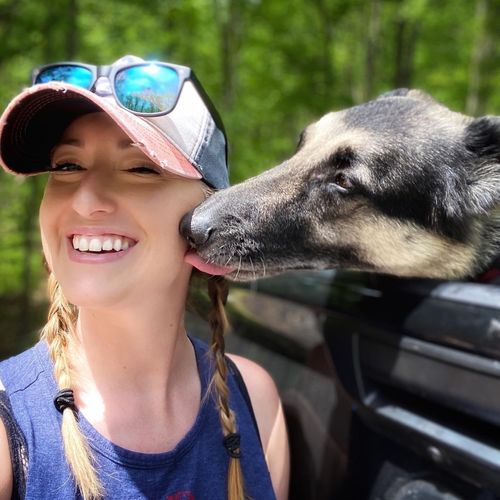
Tiffany Singleton is the owner and head trainer at Off Leash K9 Training Amarillo, specializing in advanced obedience, off-leash reliability, and service dog task training. With years of professional experience training hundreds of dogs to advanced obedience levels, Tiffany understands the precision, reliability, and temperament requirements that separate service dogs from pets.
Tiffany's approach to service dog training emphasizes real-world proofing, task reliability under distraction, and handler empowerment — because a service dog is only as effective as the team it forms with its handler. Under her leadership, Off Leash K9 Training Amarillo has earned 261+ consecutive five-star Google reviews, with many from clients who have successfully transitioned their dogs into service work.
Related Dog Training Services in Amarillo
Service dog training builds on the same advanced obedience that all of our programs provide. Depending on your needs, these related services may also be relevant:
Board and Train Programs
Our intensive board and train is the fastest path to the advanced obedience foundation every service dog needs. Learn about board and train →
Learn MoreTherapy Dog Training
Different from service dogs — therapy dogs visit hospitals, schools, and facilities to comfort others. If your goal is comfort visits, not public access, see our therapy dog program.
Learn MorePuppy Training
Building a service dog from puppyhood? Start with our puppy training program to build socialization and obedience foundations during the critical development window.
Learn MoreService Dog Training Areas in the Texas Panhandle
We provide professional service dog task training for handlers across the entire Texas Panhandle. No matter where you live, your dog can train at our Amarillo facility.
Start Your Service Dog Training Journey Today
A trained service dog can transform your independence, safety, and quality of life. Professional task training at Off Leash K9 Amarillo starts at $625 — a fraction of the $15,000-$50,000 national average. 0% financing available.
Proudly training service dogs for handlers in Amarillo, Canyon, Pampa, Plainview, Bushland, Tulia, Dumas, Borger, Hereford, and all Texas Panhandle communities.