What Equipment Do You Need for Dog Agility Training: A Beginner’s Guide in 2024
Dog agility training is a fun and rewarding activity where dogs navigate an obstacle course, showcasing their speed, agility, and intelligence. It’s a fantastic way to bond with your furry friend while providing them with mental and physical stimulation. However, starting out requires the right equipment to ensure safe and enjoyable training sessions. Using proper gear not only helps prevent injuries but also makes training more effective and accessible for beginners. If you’re wondering what equipment do you need for dog agility training, this guide covers all the essentials. From basic jumps to tunnels and weave poles, we’ll walk you through everything you need to set up your first course and begin your agility journey with confidence in 2024.Essential Equipment for Setting Up a Basic Agility Course
Setting up a basic agility course at home doesn’t have to be complicated. This section will introduce the essential equipment you’ll need to create a safe and fun course that challenges your dog and helps them learn the fundamentals of agility. Each piece of equipment serves a unique purpose, helping your dog build skills, confidence, and physical fitness. Now that you’ve got the basics covered, let’s dive into the essential equipment you’ll need to set up a fun and challenging agility course for your furry friend.Basic Agility Equipment
In this section, we’ll cover the basic equipment you’ll need to get started with agility training: a harness, a leash, and a collar. Although simple, each of these items plays an important role in training, helping you guide, control, and build trust with your furry friend. Before we delve into the exciting world of agility obstacles, let’s start with the essential gear your dog will need for training:- Harness
- Leash
- Collar
Agility Jumps
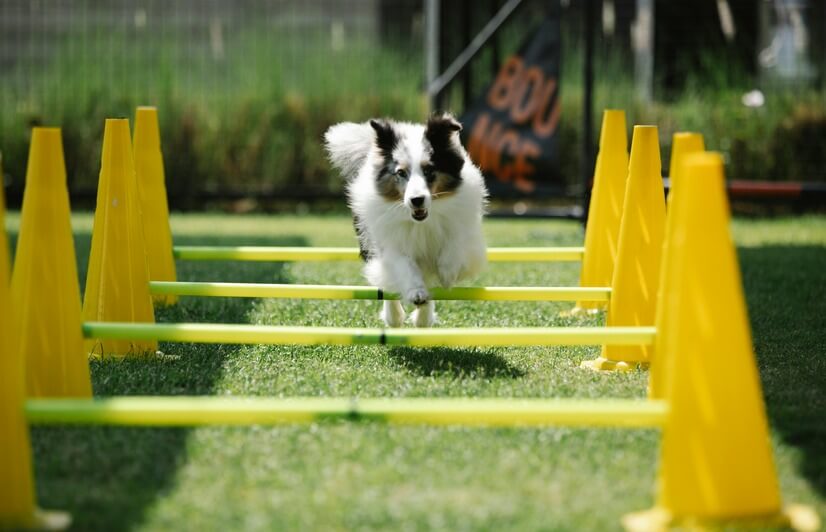
Agility jumps add a fun challenge to any agility course, helping your dog build strength, coordination, and focus. There are several types of jumps you can incorporate in your training course:- Single bar jump – the most basic jump type consisting of a single bar that the dog must clear. It’s a great starting point for introducing your dog to jumping.
- Double bar jump – The dog must leap over two bars spaced a certain distance apart, adding a bit of complexity. This helps to improve their timing and accuracy.
- Tire jump – In this type of jump, the dog jumps through a tire, which can be adjusted in height to suit different skill levels. Tire jumps are a fun and visually appealing obstacle.
- Adjustable height – Look for jumps that have adjustable heights to accommodate dogs of various sizes.
- Safe and sturdy – Ensure the jumps are made of durable materials and have stable bases to prevent accidents.
- Clearance – Make sure the bars or tires are high enough to challenge your dog without causing injury.
- Consider dog breed – Some breeds, like Border Collies and Jack Russell Terriers, are naturally inclined to jump, while others may need more encouragement.
Tunnels
Tunnels are another exciting obstacle that adds a touch of mystery and fun to your agility course. They come in various types, each with its own unique challenges. Different Kinds of Tunnels- Open tunnels – These are the simplest type of tunnel, consisting of a flexible tube that your dog can easily see through. They’re great for introducing dogs to tunnels and building their confidence.
- Collapsible tunnels – These tunnels can be collapsed and folded, making them easy to transport and store. They offer a more challenging experience as the dog can’t see what’s inside.
Weave Poles
Weave poles are a challenging and rewarding obstacle that requires precision, coordination, and a good deal of patience. They consist of a series of vertical poles that the dog must weave through in a specific pattern. Why Weave Poles Matter Weave poles are essential for agility training because they:- Improve focus – Weaving through poles requires intense concentration and focus.
- Enhance coordination – Dogs must coordinate their movements to navigate the poles efficiently.
- Build confidence – Mastering weave poles can boost a dog’s self-esteem.
- Start slow – Begin with a few poles and gradually increase the number as your dog becomes more proficient.
- Use positive reinforcement – Reward your dog for each correct weave with treats or praise.
- Practice patience – Mastering weave poles takes time and consistency. Don’t get discouraged if your dog struggles at first.
A-Frames and Dog Walks
A-frames and dog walks are known as “contact obstacles” in agility training, and they play an important role in developing a dog’s balance, confidence, and control. These obstacles require dogs to move up and down elevated surfaces, touching specific “contact zones” at the start and end.- A-frames – triangular-shaped obstacles that dogs must climb up and down. They challenge a dog’s balance and proprioception, which is the sense of where their body is in space.
- Dog walks – flat, elevated surfaces that dogs must walk across. They help to improve a dog’s balance and focus.
Pause Table
The pause table is a key element in agility training that emphasizes obedience and control. Unlike fast-paced jumps or tunnels, the pause table requires dogs to stop and sit or lie down for a set amount of time. This brief pause in the course teaches dogs to listen closely to commands and practice patience, which is essential for maintaining control in agility. Role of the Pause Table in Agility Training The pause table helps reinforce obedience by requiring dogs to switch from active movement to a controlled stop. When a dog reaches the table, they must stay in position—typically for five seconds—before continuing the course. This transition between activity and rest enhances a dog’s focus, helping them become more responsive to commands. Mastering the pause table also supports overall course flow, as it prepares dogs to respond immediately, whether stopping or starting. Choosing a Pause Table When selecting a pause table, here is a checklist you can refer to:- The table should be sturdy and stable to prevent accidents.
- Look for a table with adjustable height to accommodate dogs of different sizes.
- The surface should be non-slip to provide good traction.
- A lightweight, portable table is convenient for training and competitions.
Optional Equipment for Expanding Agility Skills
While the core equipment we’ve discussed is essential for beginning agility training, there are a few additional pieces of equipment that can help you expand your dog’s skills and elevate your training sessions. Let’s explore some optional equipment that can add variety and challenge to your agility course.Teeter-Totters (See-Saws)
The teeter-totter, or seesaw, is a fun piece of equipment that adds an element of balance and coordination. Dogs learn to walk across a board that tilts under their weight, encouraging them to stay calm and balanced as it moves. This obstacle is great for helping dogs gain confidence and develop a strong sense of body control.Chute (Closed Tunnel)
The chute, also known as the closed tunnel, is an agility obstacle that challenges dogs to enter a tunnel with an open front but a fabric “chute” at the exit. Unlike the open tunnel, where the dog can see the entire path, the chute requires the dog to push through a section of fabric they can’t see through. This encourages confidence and builds trust, as dogs learn to navigate an obstacle where the exit is hidden. Role of the Chute in Agility Training- Overcoming fear – Chutes can help dogs overcome fears of confined spaces.
- Building confidence – Successfully navigating a chute can boost a dog’s self-esteem.
- Improving focus – Dogs must rely on their senses to guide them through the tunnel.
Other Agility Accessories
Beyond the primary obstacles, there are many smaller accessories that can enhance a basic agility course and add variety to your dog’s training. Items like cones, hurdles, paw targets, marking devices, and agility mats allow you to create flexible setups and customize your course to meet your dog’s skill level and interests. These accessories are easy to use, versatile, and great for both beginners and advanced dogs looking to expand their abilities. Additional accessories to enhance and add variety to your furry friend’s basic agility course:- Cones – versatile markers that can be used to create a variety of obstacles, such as serpentine courses or slalom runs.
- Hurdles – require dogs to leap over a barrier. These can be adjusted in height to suit different skill levels.
- Paw targets – used to teach dogs to focus and respond to cues. They can also be incorporated into obstacle sequences.
- Marking devices – Clickers or verbal markers can be used to mark the desired behavior and provide immediate positive reinforcement.
- Agility mats – used to create a designated training area, protect your floors, and provide a consistent surface for your dog to practice on.
Choosing the Right Equipment for Your Dog’s Needs
When setting up an agility course for your dog, it’s important to choose the right equipment based on their size, breed, and physical condition. Additionally, the setup of your course — whether indoors or outdoors — can affect the type of equipment you use. Below, we’ll explore how to make the best choices for your dog’s agility training, along with some important safety tips to ensure a safe and enjoyable experience. Considering Your Dog’s Size and Breed Smaller dogs may require lower jump heights and smaller tunnels, while larger dogs need higher jumps and wider tunnels. Athletic breeds like Border Collies and Jack Russell Terriers may excel at agility and can handle more challenging obstacles. While less athletic breeds such as Bulldogs or Pugs may have limitations and require more gentle training. Indoor vs. Outdoor Agility Setups Indoor- Space – Consider the available space in your home or a training facility.
- Surface – Opt for flooring that provides good traction, such as rubber mats or carpet.
- Ventilation – Ensure proper ventilation to prevent overheating, especially during intense training sessions.
- Weather conditions – Be prepared for various weather conditions, such as rain, wind, and extreme temperatures.
- Ground surface – Choose a level, well-drained surface to prevent injuries. Avoid training on hard surfaces like concrete.
- Shade – Provide shade to protect your dog from excessive heat.
- Quality and durability – Invest in high-quality equipment that is sturdy and durable.
- Proper fit – Ensure that harnesses, collars, and other gear fit your dog correctly.
- Regular inspection – Check equipment regularly for wear and tear.
- Safe setup – Set up equipment in a safe manner, avoiding hazards like sharp edges or uneven surfaces.
- Start slow – Begin with basic obstacles and gradually introduce more challenging ones as your dog gains confidence.
- Listen to your dog – Pay attention to your dog’s body language and avoid pushing them beyond their limits.
Necessary Equipment for Beginner Dog Agility Trainers
Now that you have a better understanding of the essential equipment for dog agility training, it’s time to start your journey! Remember, the key to success is to start small and gradually build your dog’s skills and confidence. If you’re new to dog agility, it’s important to keep things simple in the beginning. Start with just a few key pieces of equipment that are easy to use and won’t overwhelm your dog. A basic agility course could include items like jumps, tunnels, and cones. These tools will help you introduce your dog to the fundamentals of agility without feeling like you need a full course right away. As your dog gains confidence and learns the basics, you can add more equipment to keep things exciting and challenging. You can add more challenging obstacles, such as A-frames, dog walks, and pause tables. The most important thing is to have fun and enjoy the bonding experience with your furry friend. Are you ready for this exciting adventure with your pet? If you’re excited to start or enhance your dog’s agility journey, we’ve got plenty of resources to guide you every step of the way. Explore our blog for valuable tips, tricks, and advice — not just on dog agility training, but on everything you need to know to strengthen your bond with your furry companion. Need personalized guidance? If you’re looking for professional guidance, don’t hesitate to reach out to us. Whether you need help creating a customized training plan, professional advice on agility training, or support with your dog’s training journey, we’re here to assist you. Your dog’s success starts with the right support, and we’re excited to be part of it! Let’s make your dog agility dreams a reality!Learn About Our Training Programs
Discover why we are the best dog trainers in Amarillo, TX →
Professional coaching for a happier, balanced dog.
Our Programs
Amarillo Dog Training Programs
From puppy basics to advanced off-leash obedience — every program includes our 100% guarantee
🏠
Board & Train Amarillo
Your dog lives with our trainer for 1–4 weeks. Daily video updates. Comes home transformed, 100% off-leash obedient.
From $1,400
🐾Puppy Training Amarillo
Foundation obedience, potty training, bite inhibition, and socialization during the critical learning window.
From $100
🎯Private Obedience Lessons
4 private one-on-one sessions covering sit, down, come, place, heel, and off-leash recall — at your home.
From $625
🔒Aggressive Dog Training Amarillo
Expert behavior modification for reactive, fearful, and aggressive dogs. We tackle the root cause, not just symptoms.
From $3,500
⭐Basic & Advanced Obedience
8 private sessions: first 4 build foundation commands, last 4 add advanced off-leash control and distance work.
From $950
❤️Therapy Dog Training Amarillo
Prepare your calm, gentle dog for therapy certification. Serve hospitals, nursing homes, and schools across the Panhandle.
$1,400